







Thirtieth Sunday in Ordinary Time
October 25, 2026
REFLECTION ON TODAY'S READING
To Love in Truth
Begin this day with Jesus, filled with joy and gratitude. Give thanks to Him for the gift of life and for His presence that faithfully accompanies you. Ask Him to come and fill your heart with His love and His peace.
His Word enlightens you: “You shall love the Lord your God… and your neighbor as yourself” (Mt 22:37).
Ask Him to teach you to love Him with all your heart and to recognize His face in every person you meet.
Ask Him to make you a witness to His love—attentive and compassionate.
Offer this day to Him. Ask Him to guide it according to His will and to make you open to loving in truth. Amen.
Pray the daily offering.
Under the directive from the Diocese of Honolulu
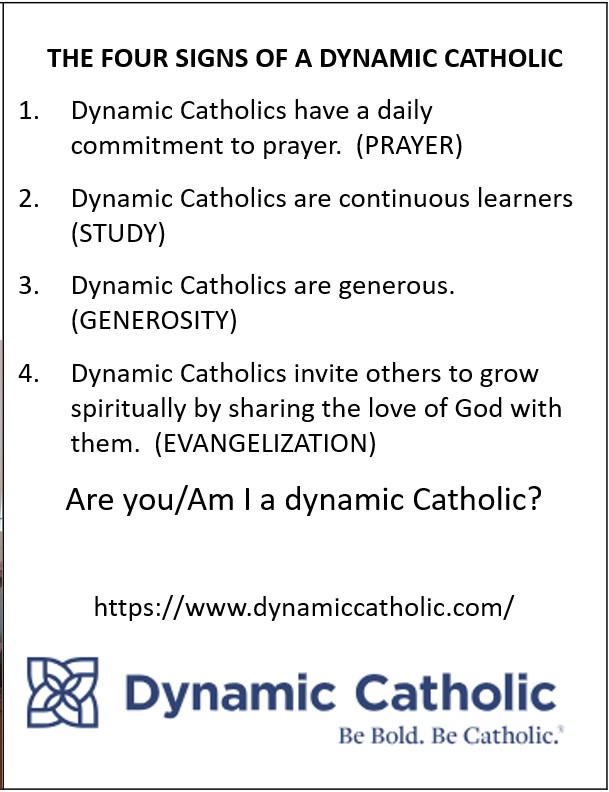
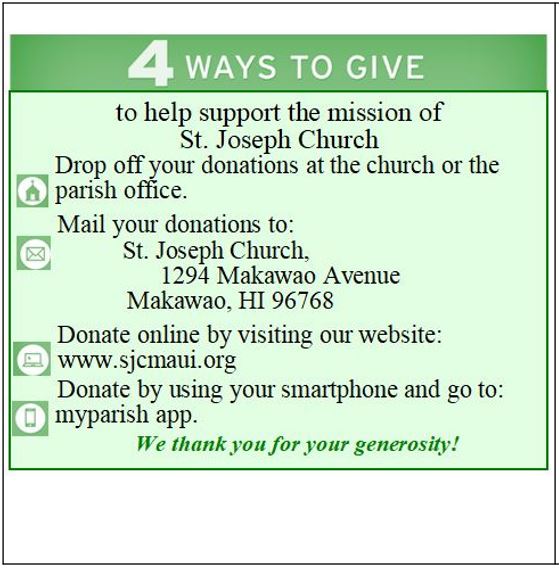
St. Joseph Church has set up an egiving program to allow parishioners and guests an easier way to give. It will also allow the donors to: 1. Give from anywhere using a computer, tablet, or smartphone. 2. No need to find a check or stop by the ATM. 3. Use your Checking/Savings Account or your Debit/Credit Card. 4. Schedule gifts to occur automatically. Click on the give now link or on your phone using my parish app. “All must give as they are able, according to the blessings given to them by the Lord your God.” Deuteronomy 16:17

Online donations may be made at any time from the comfort of your own home or any place with internet access. Online donations are credited to your tax statement for the end of the year (except when made anonymously)and you can change your account preferences and donation amounts at any time..
Saint Joseph Church Makawao - Bulletin


The Gospel Reading, Matthew 22:34-40
The Pharisees continue to test Jesus with a question about the greatest commandment.
This week’s Gospel follows close behind the Gospel read last Sunday. It is the last of three questions put to Jesus by Jewish religious leaders who are trying to trick him into saying something that might get him arrested. This reminds us that the context for today’s reading is the mounting tension between Jesus and the religious leaders in Jerusalem.
The Herodians and the Pharisees asked the first question, which was about taxes. The Sadducees asked the second question, which was about the Resurrection (see Matthew 22:22-33). The third question, considered in today’s Gospel, is asked by a Pharisee who asks Jesus about the greatest of the commandments.
The question requires Jesus to interpret the Law of Moses. The Mosaic Law consists of the Ten Commandments and many additional rules, numbering over six hundred. Adherence to the Mosaic Law, for a devout Jew, is an expression of faithfulness to God’s covenant with Israel. The ranking of the Commandments was regularly debated among the teachers of the Law.
Jesus answers the Pharisees’ question with a two-fold summary. Jesus says that all of the commandments can be summarized in two commandments: love God and love your neighbor. Both of these were central elements of the religious tradition Jesus learned from his Jewish community. Indeed these continue to be central aspects of contemporary Jewish religious understanding. Jesus’ response to his questioners proposed an integral connection between these two aspects of the Jewish Law. Love of God finds its expression in our love for our neighbor.
—
(https://www.loyolapress.com/catholic-resources/liturgical-year/sunday-connection )
.
A STEWARDSHIP MOMENT
There is one command that summarizes this weekend’s Gospel: to love. For Jesus there is no distinction between these two commands of loving God and neighbor. One naturally flows from the other. In fact, for Jesus, these commands constitute a way of life for Christian stewards; a unique approach to life and to their relationship with others. Our neighbors include everyone with whom we come into contact: family members, friends, people we don’t like, strangers and particularly those most in need of our love and compassion. Love calls us to open our hearts and do more to help others grow closer to the Lord. How might we follow Christ’s love command more fervently?
—— (https://catholicstewardship.com/)
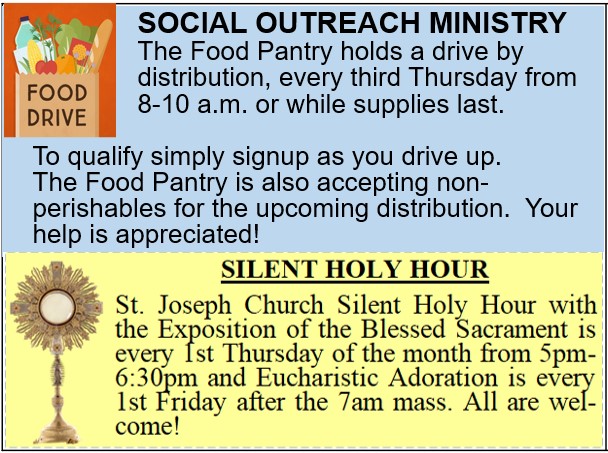
EUCHARISTIC ADORATION OF THE BLESSED SACRAMENT
First Thursday of Every Month. Come anytime between 5-6:30 pm.. All are Welcome!
THRIFT SHOP HOURS OF OPERATION
Open on Tuesdays and 1st, 2nd and 3rd Saturday of the month 8am-12 noon. Receiving donations every Monday from 8 - 10 a.m., or during normal thrift shop hours.